Table of Contents
The high score table in Ikariam is a testament to efficient empire-building, strategic resource management, and long-term planning. Understanding how the game calculates your score is the first step to climbing the ranks, followed by implementing advanced tactics used by top players.
Understanding the Score Formula
Your Total Score is not a simple sum of your actions. It is a weighted formula based on the number of citizens and the resources you have invested in three main categories: Buildings (Master Builders), Military (Generals), and Research (Scientists) . Here is the breakdown:
- Citizens: Each citizen in your empire contributes 1 point to your Total Score.
- Cargo Ships: Every 100 gold spent on cargo ships gives you 1 point (the discount from the Hermes Temple is not factored in; all ships give the same points).
- Master Builders Points: 100% of your “Master Builders” points are added to your Total Score. These are earned for every unit of resource (wood, marble, crystal, wine, sulphur) spent on constructing buildings .
- Generals Points: 100% of your “Generals” points are added to your Total Score. These are earned at a higher rate than building points (0.02 points per resource, as opposed to 0.01) for every resource invested in military units and ships .
- Scientists Points: A massive 600% of your “Scientists” points are added to your Total Score. These points are earned for every research point spent on completed technologies .
The formula: Total Score = [Citizens] + [Gold spent on ships]/100 + [Generals] + [Master Builders] + [Scientists] x 6 .
Key Takeaway for Score Hunters
The 600% weighting on Scientists points is the most critical factor. Top players in the high score rankings consistently dominate in the Scientists, Master Builders, and Citizens categories . This means that a strategy focused on research and construction yields far more high-score points than a purely military one .
The Late-Game Blueprint
To break into the top ranks, you need to transition from early-game survival to a strategic late-game phase focused on these core objectives:
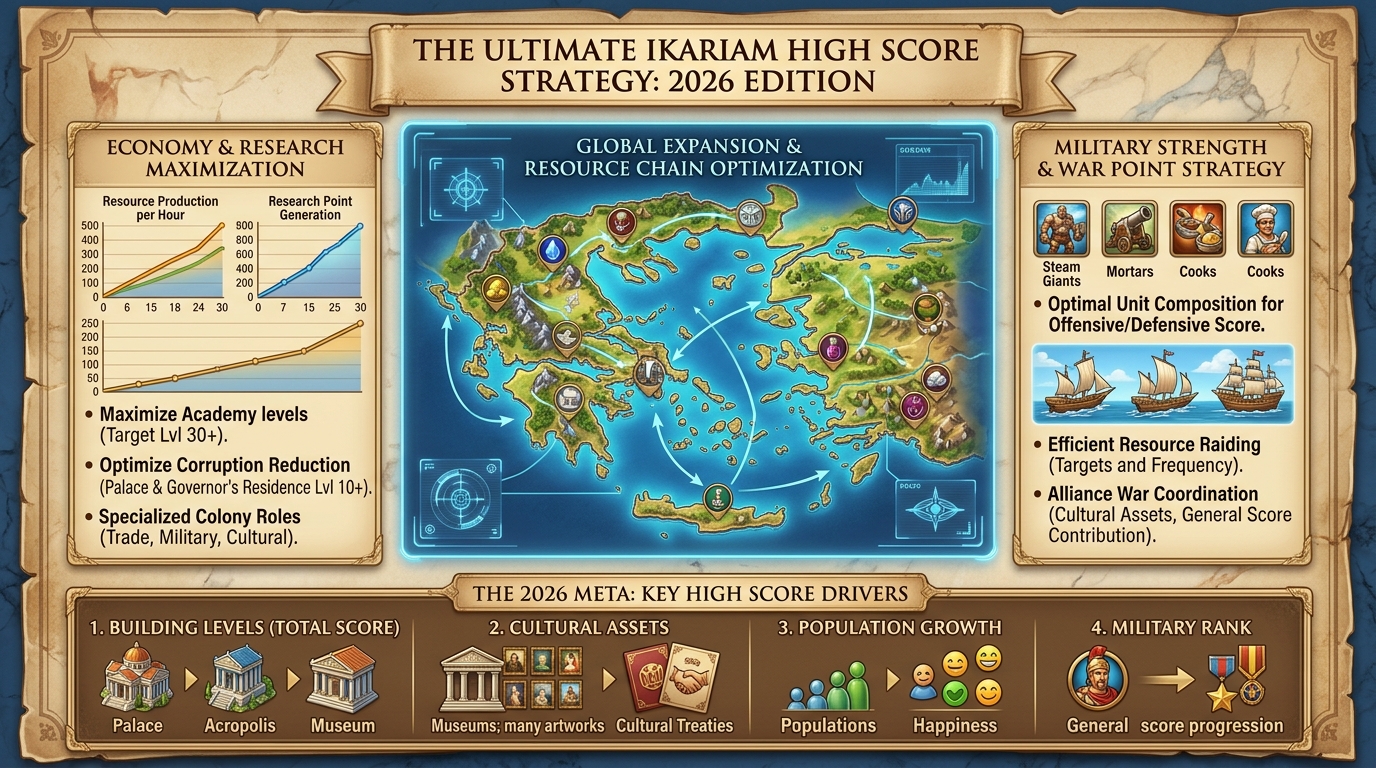
- Maximise Research: Keep your Academies working continuously. The “Future” technologies (Economy, Science, Seafaring, Military) are a long-term goal for high-level players, providing a percentage boost to your empire .
- Expand Your Empire: Build 9, 10, or even 11 towns. More towns mean more citizens, more researchers, more gold, and a larger army than a player with only 7 or 8 towns .
- Invest in Infrastructure: The long-term focus should be on the “Master Builders” score. Build and upgrade your resource-reducing buildings (Carpenter, Architect’s Office, etc.) to level 32 or higher. These savings are vital for funding the astronomical costs of late-game buildings .
- Centralise Your Resources: Don’t spread your military and resources across all cities. Create a single, heavily fortified “capital” or “fortress” town with a high-level Hideout to protect your wealth, making it an unappealing target .
Advanced Tactics of High-Score Players
The General Bank (Bunker Account)
One of the most powerful tactics used by top alliances is the creation of a “General Bank,” also known as a “Bunker” .
- How it works: A lower-point account within an alliance is designated as a General Bank. Other, higher-point players in the alliance send resources to this account, which then uses them to build a massive, passive military .
- The Advantage: This enormous army can be kept in reserve during peacetime. The main account can be left in Vacation Mode to avoid the crippling gold upkeep. In a war, the account is taken out of Vacation Mode, and the army is deployed, giving the alliance a massive, sudden military advantage .
- The Catch: This tactic is considered highly controversial, but it is widely used by competitive alliances . It relies on the fact that it is not against the rules to send troops from a higher-point account to a lower-point account .
High-Risk Market Manipulation
Some players attempt to influence their local market to generate massive gold income, which can be used to fund a large army or buy more cargo ships.
- The Tactic: Buying out all the cheap offers of a resource and relisting them at a much higher price. This can raise the local market price over time, allowing the player to sell their own resources for a massive profit .
- The Risk: This strategy is extremely risky. It frequently violates the game’s “pushing” rule, which prohibits unfair profit from lower-ranked accounts. Many players have been banned for this .
Pillaging Inactives
A safer, high-yield activity for generating resources is to focus on pillaging inactive players. These accounts accumulate unprotected resources that can be looted for huge gains, often tens of thousands of resources at a time, with very little cost .
The Long Game
Climbing the high score table is not a short-term goal. It requires a shift in mindset from quick gains to long-term empire-building . The key is to be patient, prioritise economic and research growth, and learn the advanced strategies used by the veteran players on the top of the leaderboard. If you are dedicated, you can aim for the final milestone: breaking into the top 500 on the high scores .